

NEWS
JAMSS Researcher Presented at the 16th IFAC Symposium on Analysis, Design, and Evaluation of Human–Machine Systems
2025.12.25


Dr. Takayuki Hirose delivered the opening address as Vice Chair of IFAC Technical Committee 4.1: Human–Machine Systems at the 16th IFAC Symposium on Analysis, Design, and Evaluation of Human–Machine Systems held in November 2025. He is a researcher at JAMSS’s Advanced Technology Research Center and a Junior Associate Professor at Kyoto University’s Center for Interdisciplinary Studies of Law and Policy. He also served as a panelist during the symposium.
The International Federation of Automatic Control (IFAC), established in 1957, is a long-standing international academic organization that promotes research collaboration and technological exchange in control engineering and systems engineering. Its activities support the advancement of automation technologies across a wide range of fields, including industry, transportation, and space. Within IFAC, Technical Committee 4.1 on Human–Machine Systems plays a vital role in exploring how safe, reliable, and enriching technologies and societies can be created through effective human–machine collaboration.
In his opening address, Dr. Hirose highlighted the rapid changes surrounding human-machine systems in recent years, noting in particular how the widespread adoption of generative AI since the previous symposium in 2022 has prompted a fundamental re-examination of the relationship between humans and machines. He further emphasized that the accelerated pace of technological advancement and the growing complexity of society have created new challenges and opportunities, as systems become interconnected in unprecedented ways. Against this backdrop, Dr. Hirose stressed the significance of this symposium as a valuable forum for reconsidering the future of human–machine collaboration within broader socio-technical contexts. In the end, he concluded by expressing his gratitude to the presenters, session chairs, reviewers, organizing committee members, and volunteers who contributed to the event, and by sharing his hopes for active discussions and a productive meeting among all participants.
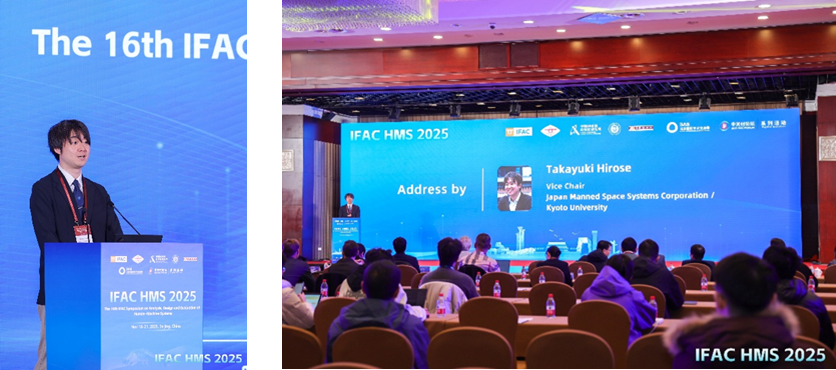
Opening Address
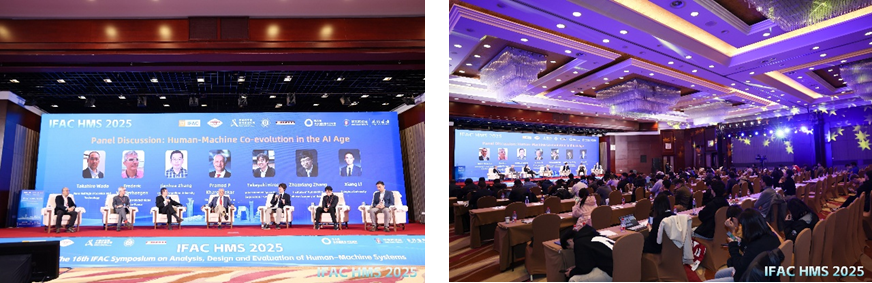
Panel Discussion
In addition to his opening address, Dr. Hirose joined the panel discussion, titled “Human-Machine Co-evolution in the AI Age.” The session explored how the growing integration of AI is reshaping the relationship between humans and machines, addressing a wide range of perspectives including safety, bias, and creativity. Dr. Hirose contributed several key insights, including:
On whether AI can exhibit creativity and flexibility
Dr. Hirose noted that, while humans are often portrayed as a source of variability or instability in safety-critical contexts, they in fact possess a unique strength: the ability to actively interact with their environment, make sense of unfolding situations, and adapt flexibly. This human “variability,” which enables context-sensitive judgment and action, differs fundamentally from approaches such as deep learning, which rely on static datasets. He emphasized that such adaptive, fluctuation-based capabilities play a crucial role in responding to rapidly changing environments.
In response to an audience question about whether advances in AI might diminish the role of humans
Dr. Hirose emphasized that, in reality, “slightly imperfect automation” remains widespread, and it is precisely these highly capable yet not fully autonomous systems that demand the most careful design and operation. Achieving “100% automation” would require complete control over all environmental factors — including pedestrians, weather conditions, and other sources of variability — making the full elimination of human and contextual uncertainty extraordinarily difficult. For this reason, mechanisms that ensure safety and reliability through human–machine cooperation will continue to be indispensable, regardless of how advanced AI becomes. The importance of this theme, he noted, will not diminish even as automation technologies further evolve.
Message from Dr. Hirose
It is a great honor for me to deliver the opening address and serve as a panelist at such a distinguished venue as IFAC, and I am delighted that the symposium concluded successfully. As I mentioned in my opening remarks, the landscape surrounding the relationship between humans and machines has undergone significant change in recent years. Precisely because technology has advanced so rapidly, I believe now is the time to re-examine the role of human beings and to consider how we can build safer, more reliable, and more enriching technologies and societies through collaboration between humans and machines.
Beyond the space industry, many of the technologies and systems that underpin modern society are evolving as “socio-technical systems” in which humans, machines, and context are intricately interconnected and function together. Ensuring the safety of these systems and maximizing their value is essential not only for the crewed space activities in which JAMSS specializes, but also for a wide range of rapidly advancing fields such as AI, autonomous driving, and IoT. As a “system integrator connecting people and space,” JAMSS will continue to actively promote international technical exchange and contribute to enhancing safety and reliability across a broad spectrum of domains.


CONTACT
Inquiries
Please use our inquiry form for any question.
Please feel free to contact us.
If you are in hurry, please contact us via phone:
Japan Manned Space Systems Corporation Marketing and Contract Department
Tel: +81-3-3211-2060
(Between 10AM and 5PM on weekdays)